Artificial intelligence inference at the tactical edge — onboard a vehicle, aircraft or unmanned platform — imposes constraints that datacentre AI does not face. Power budgets are measured in tens of watts, not kilowatts. Thermal envelopes are fixed. Environmental qualification is mandatory. Yet the compute demand for real-time EO/IR target recognition, sensor fusion and ISR exploitation continues to increase. This guide helps defence engineers navigate the platform selection decision.
The Three AI Accelerator Families
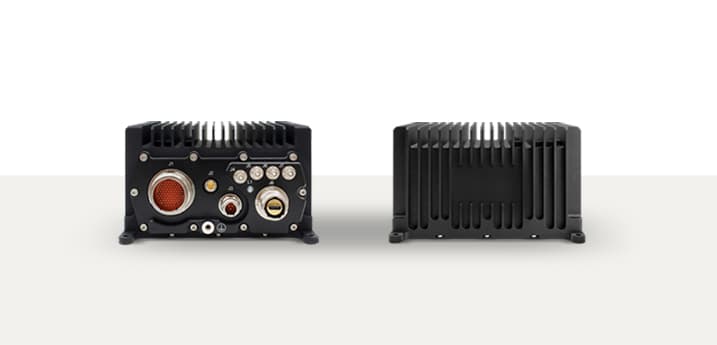
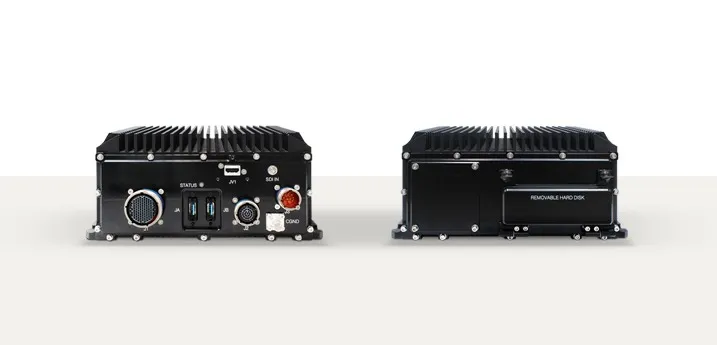
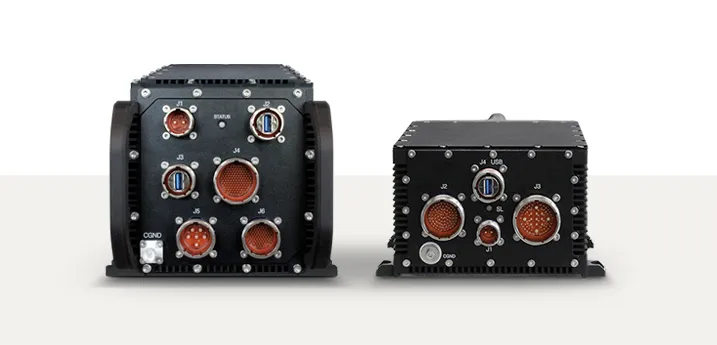
- ›NVIDIA Jetson SoMs (Orin NX, Orin AGX): Integrated CPU + GPU + DLA (Deep Learning Accelerator) on a single module. SWaP-optimised — as low as 10–60W. Ideal for UAVs, vetronics and small airborne platforms. GOMA AIX Series integrates Jetson Orin in a MIL-qualified conduction-cooled chassis.
- ›Discrete GPU cards (NVIDIA RTX / L-series / A-series): Higher throughput — hundreds of TOPS. PCIe form factor. Require higher power and active cooling. Suited to rackmount radar/EW servers and shelter computing (GOMA XRS Series).
- ›FPGA accelerators (Xilinx/AMD Versal, Intel Agilex): Deterministic, low-latency inference. Reconfigurable. Lower peak throughput than GPUs but ideal for hard real-time applications like radar signal processing. Typically on VPX or PCIe cards.
Key Decision Criteria
- ›Power budget: If total platform power is below 100W, Jetson Orin is the practical choice. Above 150W, discrete GPU cards become viable.
- ›Thermal: Fanless conduction-cooled installations require integrated SoM solutions. Forced-air environments can accommodate discrete GPUs.
- ›Framework support: PyTorch, TensorFlow and ONNX are well-supported on NVIDIA (CUDA ecosystem). FPGA deployment requires model conversion and vendor-specific toolchains.
- ›Latency vs throughput: Hard real-time (<1 ms) inference favours FPGAs. Throughput-optimised batch inference favours GPUs.
- ›Qualification maturity: NVIDIA Jetson Orin-based platforms have a growing track record in MIL-qualified form factors. Discrete GPU cards in ruggedised chassis are more established for server applications.
EO/IR and Target Recognition
For electro-optical and infrared target recognition on UAVs and helicopters, NVIDIA Jetson Orin AGX (275 TOPS) provides sufficient throughput for real-time inference with common object detection networks (YOLOv8, RT-DETR) at video frame rates. Power consumption of 25–60W fits within UAV payload budgets. GOMA AIX Series provides a MIL-STD-810 and DO-160G qualified chassis for Jetson Orin integration with MIL circular connector I/O.
ISR and Sensor Fusion
Intelligence, Surveillance and Reconnaissance (ISR) exploitation — fusing radar, EO/IR, SIGINT and geospatial data — typically requires higher throughput than a single Jetson SoM can deliver. Rackmount systems with NVIDIA RTX A4000 or A5000-class GPUs (16–24 GB VRAM, 150–230W) provide the necessary compute for multi-stream inference and large model inference. These platforms require forced-air cooling and are suited to shelter or vehicle-rack installations.
Model Optimisation for the Edge
Regardless of accelerator choice, model optimisation is critical for edge deployment. Quantisation (INT8, FP16) typically reduces model size by 2–4× with minimal accuracy loss and doubles throughput on Tensor Core-equipped GPUs. NVIDIA TensorRT converts trained models to optimised inference engines for Jetson and discrete GPU targets. FPGA deployment requires conversion via Xilinx Vitis AI or Intel OpenVINO. Budget time for model optimisation and validation as part of your programme schedule — it is not a trivial step.