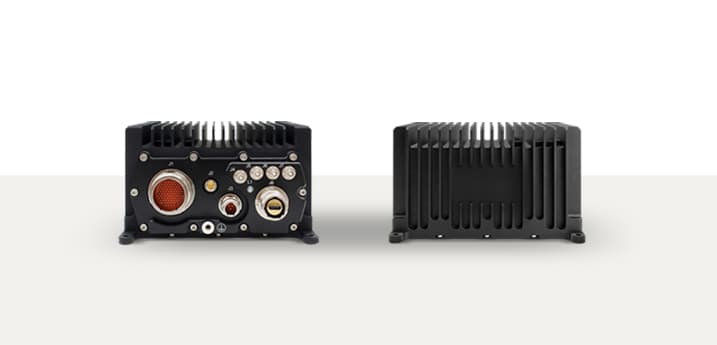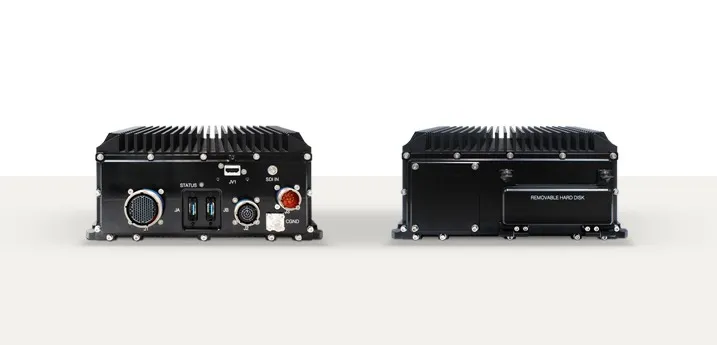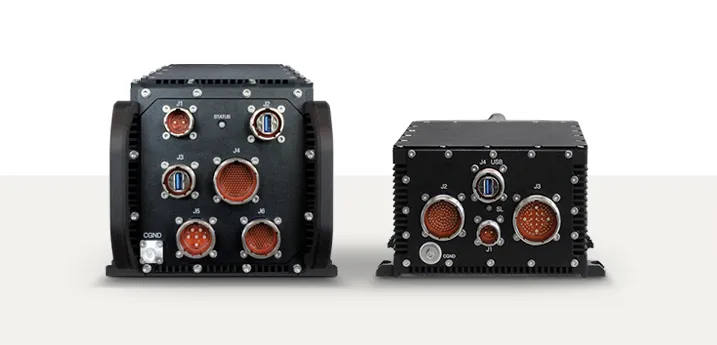
Two competing philosophies dominate rugged mission computing architecture: modular VPX open architecture and integrated COTS rackmount platforms. Both have a place in defence programmes — the right choice depends on your programme’s maturity, compute requirements, integration timeline and upgrade strategy. This guide provides a structured comparison.
What Is OpenVPX?
OpenVPX (VITA 65) is an open standard that defines backplane profiles, slot profiles and module profiles for 3U and 6U VPX (VITA 46) modular computing. An OpenVPX chassis accepts plug-in modules — processor boards, GPU cards, signal processing boards, switch modules — from multiple vendors on a standardised backplane. This modularity enables reconfigurable, scalable computing architectures. The US and NATO communities have extensively standardised on OpenVPX for new sensor and mission computing programmes under the Modular Open Systems Architecture (MOSA) initiative.
What Is COTS Rackmount?
Commercial Off-The-Shelf (COTS) rackmount rugged computers are integrated chassis — a fixed mechanical and thermal design containing a specific set of compute resources (processor board, storage, GPU, I/O) in a 1U–4U rack-mount enclosure. They are designed for rapid integration: connect power, network and I/O cables and the system is operational. COTS rackmount platforms have a lower NRE cost and shorter integration timeline than custom VPX builds, but offer less hardware reconfigurability.
When to Choose OpenVPX
- ›Long-programme reconfigurability: If the compute payload will change significantly during the programme life (new sensor, new AI accelerator), VPX slot-based modularity allows hardware upgrades without chassis replacement.
- ›MOSA compliance requirement: US DoD and some allied programmes mandate MOSA/OpenVPX compliance for new sensor and mission computing systems.
- ›Custom signal processing chains: Radar, EW and SIGINT systems requiring specific combinations of FPGA, DSP and GPU modules benefit from VPX backplane modularity.
- ›Multi-vendor sourcing: OpenVPX standardisation allows sourcing individual modules from multiple vendors, reducing single-source risk.
When to Choose COTS Rackmount
- ›Fast integration timelines: If programme schedule is the primary constraint, a qualified COTS rackmount platform reduces integration effort by months versus a custom VPX build.
- ›Fixed compute requirements: If the required compute resources are well-defined and unlikely to change, the cost and complexity of VPX modularity is unnecessary.
- ›Shelter and vehicle rack integration: COTS 1U–4U rack servers integrate directly into standard 19-inch racks in C2 shelters and naval bays without a custom chassis design.
- ›Cost-sensitive programmes: VPX chassis, backplanes and modules carry significant unit cost premium over integrated COTS platforms delivering equivalent compute.
The Hybrid Approach
Many programmes combine both architectures: a COTS rackmount server handles data management, networking and HMI functions, while a VPX subsystem handles high-rate sensor processing. This provides the integration simplicity of COTS for standard compute functions while preserving VPX reconfigurability for the signal processing chain. GOMA supports both approaches — GAP and XRS Series for COTS rackmount, MAG Series for VPX mission computing.